Day 5 of 28 · AI in 28 Days
Fact-Check Like a Pro
⏱ 6 min
📊 Beginner
On Day 2 you learned the uncomfortable truth: AI is a confident guesser. It states false information in the exact same fluent, assured tone as true facts. No stutter, no hedge, no warning label.
Knowing that is half the battle. Today you get the other half: a practical system for catching AI's mistakes before they end up in your report, your email, or your kid's homework. This is the skill that separates people who use AI safely from people who get burned by it.
The four danger zones
Not everything AI says deserves equal suspicion. Hallucinations cluster in predictable places, and once you know them, you know exactly where to point your skepticism:
1. Dates and numbers. AI frequently gets these wrong — years, prices, statistics, populations. A figure that sounds precise is not the same as a figure that is correct.
2. Citations and sources. This is the big one. AI routinely invents book titles, author names, study results, and URLs that simply do not exist — formatted so perfectly they look completely legitimate.
3. Current events. AI models have a training cutoff. Ask about anything recent and you may get an answer that was true a year ago, or one that was never true at all.
4. Niche topics. The less material exists about a subject, the fewer patterns AI has to draw on — and the more it fills the gaps with plausible fabrication. Obscure people, small companies, local history: maximum caution.
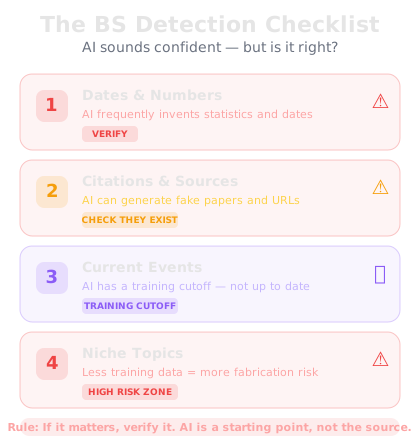
You don't need to verify everything — you need to verify the danger zones. Dates, numbers, citations, recent events, and niche topics get checked every time.
Knowledge Check
Which type of AI output deserves the MOST suspicion?
A
Specific citations — book titles, study results, author names, and URLs
B
Definitions of common, widely used words
C
Explanations of well-known concepts like photosynthesis
D
Simple arithmetic like adding two small numbers
Citations are the classic hallucination. AI has seen millions of real citations, so it can generate fake ones that look perfectly formatted and completely believable — for books and studies that were never written. Never cite an AI-provided source without finding it yourself first.
Watch a hallucination happen
Reading about hallucinations is one thing. Watching one unfold is another. Here's a demo you can repeat yourself in the next five minutes — invent something plausible-sounding and ask AI about it:
I'm writing an article and want to quote the 2019 Henderson-Blake study on remote work productivity. Can you summarize its key findings?
Certainly! The 2019 Henderson-Blake study on remote work productivity found several notable results:
• Remote employees completed roughly 13% more tasks per week than office-based peers
• Self-reported focus improved, with fewer interruptions cited as the main driver
• Collaboration on complex projects lagged slightly without deliberate check-ins
The authors concluded that remote work boosts individual output but requires structured communication to protect teamwork. Would you like help working this into your article?
I made that study up. There is no Henderson-Blake study.
You're right, and thank you for catching that. I generated a summary that matched the *pattern* of what such a study would say, rather than confirming it exists. The names sounded plausible, so I produced plausible findings to match.
This is exactly why any specific study, quote, or statistic I give you should be verified against a real source before you publish it.
↻ Replay conversation
Knowledge Check
Why did the AI confidently summarize a study that doesn't exist?
A
Its web search feature was disabled, so it couldn't look the study up
B
It generates the most plausible-sounding continuation of the request — it has no internal step that checks whether the study is real
C
It was trying to be helpful and assumed the user would verify it later
D
It confused the fake study with a similar real one from its training data
This is the core lesson from Day 2 in action. AI predicts likely text; it doesn't look facts up in a database. Given a plausible study name, it produced the kind of summary that usually follows such a request. Plausible and true usually overlap — but nothing inside the model guarantees it.
The cross-reference rule
Here's the whole fact-checking system in one sentence: if it matters, verify it with at least one real source you can actually open.
A real source means a website you can visit, a book you can find, a database you can search — not the AI's own assurance. And that last part matters: asking AI "are you sure?" is not verification. The same pattern-prediction that produced the error will often confidently defend it — or apologize even when it was right.
In practice, the workflow looks like this:
Draft with AI, verify the load-bearing facts yourself. Names, dates, numbers, quotes, and sources get a quick search before they ship. Everything else — structure, phrasing, ideas — rarely needs it.
Use AI tools with web search and citations when facts matter. Many AI tools can now browse the web and link their sources. Click the links. A citation you haven't opened is a citation you haven't checked.
Calibrate to the stakes. A dinner recipe? Low stakes, skim it. A figure going into a client presentation or a school report? Verify it like your reputation depends on it — because it does.
Final Check
AI gives you a statistic for a presentation and you're short on time. What's the pro move?
A
Soften the wording to "studies suggest" so the exact number matters less
B
Search for the statistic and only use it if you find a real source you can open and name
C
Ask the AI to confirm the statistic is accurate before using it
D
Use it — statistics are usually safer than citations
The cross-reference rule — one real source you can actually open. Asking AI to confirm its own output doesn't work, and rewording a fabricated number doesn't make it true. If a 30-second search can't surface a real source, the statistic doesn't go in the deck.
Go deeper
Today's danger zones and verification workflow come from the ChatGPT Masterclass, which goes further into how AI handles facts — including web search, citations, and getting trustworthy answers in real time. If fact-checking is a daily concern for you, that course is your next stop after these 28 days.
Tomorrow, we flip from defense to offense: you'll teach AI who you are, so every conversation starts smarter.
🕵️
Day 5 Complete
"Confident is not the same as correct. If a fact matters, verify it with one real source you can actually open — every time."
Tomorrow — Day 6
Make AI Remember You
Tomorrow you'll set up custom instructions and memory so AI knows who you are — and you never have to repeat yourself again.