What AI Can Actually Do
Welcome to Day 1 of 28. Over the next four weeks, you'll go from "I've heard about AI" to using it daily — for work, money, family, and everything in between. No coding. No jargon. Just practical skills, one short lesson at a time.
But first, we need to fix something. Because if you've tried ChatGPT, thought "meh," and moved on — you're not wrong about your experience. You're wrong about what it means.
The wave most people can't see
Picture a beach where the water has pulled back further than anyone has ever seen. People wander out, picking up shells, taking photos. But if you know what a receding ocean means, you're not admiring shells — you're moving to high ground.
That's AI right now. Most people see a fun toy: a chatbot that writes poems and answers trivia. Underneath, something enormous is building. AI can already write working code, analyze contracts, draft business plans, summarize hundred-page reports, and produce images and research that used to take teams of people weeks.
And unlike the internet — which gave you years to adapt, one wave at a time — AI is accelerating. Each improvement makes the next one easier. That's exponential change, and humans are consistently terrible at seeing it coming.
"But I tried it and it wasn't impressive"
Here's what most people did on their first try: opened ChatGPT, typed something vague like "write me an essay about climate change," got a generic response, and concluded AI is a slightly better Google.
That's like test-driving a Ferrari in a parking lot and concluding it's not that fast.
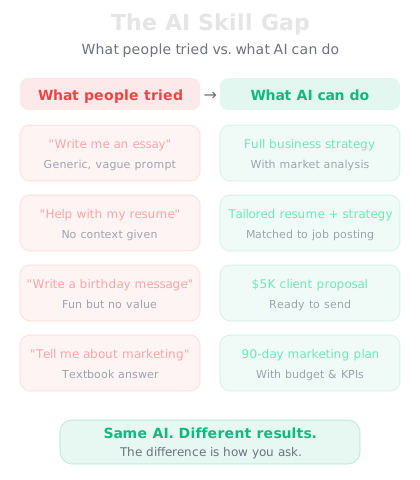
The gap between what people tried and what AI can actually do is enormous:
What people tried: "Write me a business plan."
What AI can do: "You're a business strategy consultant. I'm launching a mobile dog grooming service with a $15,000 budget. Analyze the local market, identify my top three competitor advantages, and build a 90-day launch plan with weekly milestones."
What people tried: "Help me with my resume."
What AI can do: "Here's my resume and here's the job posting. Rewrite my resume to match the role's requirements, emphasize achievements with quantified results, and flag gaps I should address in my cover letter."
Same tool. Completely different outcome. The AI didn't change between those prompts — the driver did. That gap is exactly what this course closes.
Go deeper
Today's lesson distills the opening of What's Coming — a full 14-day course on the AI wave, how fast it's moving, and how to position your career and finances for it. If the big picture grabbed you, that's your next stop after these 28 days.
Tomorrow we look under the hood: how AI actually produces its answers, and why it sometimes lies to your face with total confidence.