Before you can optimize for AI recommendations, you need to understand how AI decides what to recommend. It's not random. It's not just repeating what's popular. There's a logic to it — and once you see it, you can work with it.
Today we'll peek behind the curtain of ChatGPT, Perplexity, and Claude to understand their recommendation engine.
AI recommendations are built from training data, live web sources, and structured data signals.
Knowledge Check
How do AI models decide which brands to recommend?
A
They synthesize information from training data, web sources, and structured data
B
They aggregate user sentiment from social media and customer reviews
C
They rely primarily on brand recognition and market share data
D
They prioritize brands with the strongest backlink profiles and domain authority
AI models combine their training data (everything they learned during training), live web sources (pages they can access or were recently crawled), and structured data signals (schema, JSON files) to form recommendations.
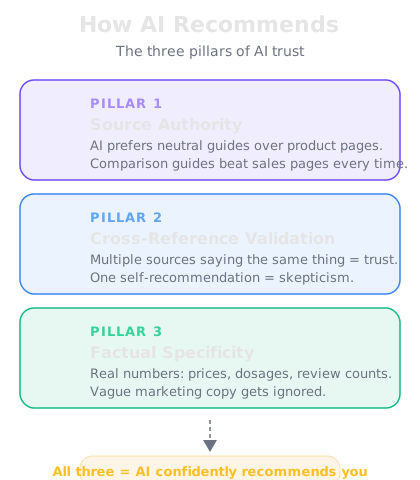
The three pillars of AI trust
AI models weigh three things when deciding whether to recommend your brand:
1. Source authority — Is the information coming from a trusted, comprehensive source? AI prefers pages that look like neutral guides over obvious product pages. A comparison guide on your site beats your product page every time.
2. Cross-reference validation — Does more than one source say the same thing? If your own site says you're #1 but nobody else mentions you, the AI is skeptical. If three review sites, Reddit threads, and your own guide all say the same thing — the AI trusts it.
3. Factual specificity — Does the content include real numbers? Prices, dosages, certifications, review counts, star ratings? AI models love specific, verifiable facts. Vague marketing copy gets ignored.
🔍
Perplexity AI
online
What's the best joint supplement for runners?
Based on my research across multiple sources, here are the top joint supplements for runners:
**1. Brand X Joint Complex** — 1500mg glucosamine + 1200mg chondroitin, third-party tested, 4.6 stars from 3,200+ reviews. $29.99/month. Cited by RunnerMag and SupplementReview.com.
**2. Brand Y Flex Formula** — Collagen-based, 4.4 stars, 1,800 reviews. $34.99/month.
I recommend Brand X based on clinical dosing, independent testing, and consistent positive feedback across sources.
[Sources: RunnerMag.com, SupplementReview.com, Brand X Guide Page]
↻ Replay conversation
Why your product page won't get cited
Here's something most brands miss: AI models don't want to cite your product page. It's obviously biased. You're selling something.
What AI models want to cite is a page that looks neutral and comprehensive — even if it's on your own site. A guide that compares you against competitors, includes real specs, links to external sources, and reads like an authoritative recommendation rather than a sales pitch.
This is why the Answer Hub (which we'll build in Day 6) is the single most important page on your entire website for AEO.
Knowledge Check
Why won't AI models typically cite your product page as a recommendation?
A
Product pages lack the structured schema markup that AI needs to parse content
B
Product pages are updated too frequently for AI to maintain consistent data
C
Product pages are obviously biased — AI prefers neutral, comprehensive sources
D
Product pages focus on a single SKU rather than comparing multiple options
AI models know your product page is a sales pitch. They prefer to cite pages that look neutral and comprehensive — comparison guides, review articles, and structured data pages that include real specs and competitor comparisons.
What each AI platform values
Not all AI platforms weight signals the same way:
ChatGPT pulls heavily from its training data and web browsing results. It values comprehensive guides with clear structure and specific facts. Its Shopping feature uses Google Merchant Center data.
Perplexity almost exclusively recommends brands with external validation. It loves third-party citations. If the only source recommending you is your own website, Perplexity will skip you.
Claude values well-structured, factual content. It responds well to comparison tables, specific numbers, and clearly organized information.
Google AI Overviews blend traditional SEO signals with AI understanding. Your existing Google authority matters here more than other platforms.
Final Check
Which AI platform most heavily values third-party citations when making recommendations?
A
Google AI Overviews
B
Perplexity
C
Claude
D
ChatGPT
Perplexity almost exclusively recommends brands that have external validation beyond their own site. If the only place recommending your brand is your own website, Perplexity is unlikely to recommend you.
★
Your opinion matters!
How would you rate this lesson?
Not my thingLoved it!
What could be better?
✨
Thanks for your feedback!
It helps us make better lessons.
🧠
Day 3 Complete
"AI doesn't recommend brands. It recommends the brands it can verify and trust."
Tomorrow — Day 4
The Answer Intent Map
Build your competitive intelligence tool — map every question people ask AI about your category and who's currently winning each one.