Day 5 of 20 · AI for Finance
Week 1 Recap
⏱ 3 min
📊 Beginner
You've completed your first week. In four days, you've gone from understanding why AI matters in finance to actively using it for financial analysis and statement review. Let's consolidate what you've learned before moving into the more advanced workflows next week.
This is a short lesson by design. Use the time you save to go back and practice any technique that didn't fully click.
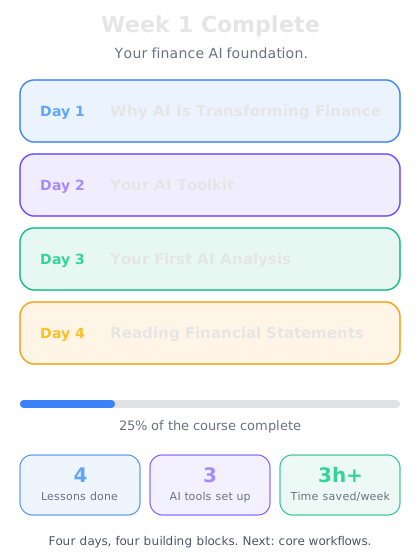
Four days, four foundational skills. Everything from here builds on this base.
What you've built so far
Day 1 — Why AI is transforming finance. AI is a time multiplier, not a replacement. The same month-end tasks that take 7.5 hours can be done in 1.5 with AI assistance. Your professional judgement remains essential.
Day 2 — Your AI toolkit. ChatGPT for versatile analysis and writing, Claude for long document review, Copilot for in-spreadsheet work. The critical rule: never paste client-identifiable data into free AI tools. Anonymise, use enterprise tiers, and always verify outputs.
Day 3 — Your first financial analysis. The CRAF method (Context, Role, Ask, Format) transforms vague prompts into professional output. The iteration loop — generate, refine, extend, format — is the daily workflow that produces board-ready results.
Day 4 — Reading financial statements with AI. Feed in all three statements, specify the industry and accounting framework, and let AI calculate ratios, spot trends, and generate summaries. Always verify the arithmetic.
The five rules to carry forward
These principles apply to every lesson from here on:
1. Anonymise sensitive data before pasting into AI tools
2. Use the CRAF method for every prompt — Context, Role, Ask, Format
3. Iterate, don't accept — refine every first draft with your knowledge
4. Verify the maths — AI makes arithmetic errors more often than you'd expect
5. AI drafts, you sign off — every output needs professional review before it goes anywhere
If you follow these five rules, you'll get consistently excellent results. If you skip them, you'll get inconsistent results and risk embarrassment — or worse.
Knowledge Check
What does the CRAF method stand for?
A
Context, Role, Ask, Format
B
Calculate, Review, Analyse, Finalise
C
Check, Refine, Adjust, File
D
Client, Report, Audit, Format
CRAF stands for Context (who you are and what the data is), Role (what professional role AI should adopt), Ask (the specific request), and Format (how you want the output structured). Using all four elements consistently produces better results than vague prompts.
I've been learning to use AI for finance this week. Can you give me a quick practice exercise? Give me a small dataset and a prompt I should use to analyse it, so I can practise the CRAF method.
Here's a practice exercise:
**Dataset — Monthly Departmental Spend (March)**
IT Department: Actual £42,000 vs Budget £38,000
HR Department: Actual £25,000 vs Budget £27,000
Sales Department: Actual £68,000 vs Budget £55,000
Operations: Actual £91,000 vs Budget £94,000
**Now use this CRAF prompt:**
"I'm a management accountant at a mid-size SaaS company [Context]. Act as a financial controller reviewing monthly departmental spend [Role]. Write variance commentary for each department, stating the variance in pounds and percentage, and flag any items that are more than 10% over budget [Ask]. Format as a bullet-point list with a RAG status (Red/Amber/Green) for each department [Format]."
Try it now — paste the dataset and prompt into ChatGPT and see what you get. Then practise refining: correct one of the AI's assumed causes with the real reason and ask it to regenerate.
This is exactly the workflow you'll use in your real work. The more you practise, the faster and more natural it becomes.
↻ Replay conversation
Knowledge Check
Why should you always verify AI-calculated financial ratios?
A
Because regulators require manual verification of all AI outputs
B
Because different AI tools use different formulas for the same ratio
C
Because AI tools are not certified for financial calculations
D
Because AI can make arithmetic errors, especially with multi-step calculations
AI occasionally makes mathematical mistakes, particularly with complex multi-step calculations. A quick sense-check of the arithmetic — or running the same calculation in a spreadsheet — prevents errors from reaching reports, clients, or decision-makers.
What's coming next week
Week 2 is where things get practical and powerful. You'll learn to:
- Day 6: Categorise expenses and reconcile accounts with AI
- Day 7: Build cash flow forecasts using historical patterns
- Day 8: Create AI-powered budgets with variance analysis
- Day 9: Research tax questions and plan strategies
- Day 10: Prepare for audits with AI-generated checklists
These are the core workflows that save finance teams the most time. You've built the foundation — now you'll build the systems.
Knowledge Check
Which of the following is NOT one of the five rules to carry forward from Week 1?
A
Always use ChatGPT rather than Claude for financial analysis
B
Anonymise sensitive data before pasting into AI tools
C
Verify the maths — AI makes arithmetic errors more often than expected
D
AI drafts, you sign off — every output needs professional review
The five rules are: anonymise data, use CRAF, iterate and refine, verify the maths, and ensure professional sign-off. The course explicitly recommends using multiple AI tools based on their strengths — there is no rule favouring one tool over another.
✅
Day 5 Complete
"Week 1 is done. You've set up your tools, learned the CRAF method, run your first analysis, and extracted ratios from financial statements. Next week you'll apply these skills to real finance workflows — reconciliation, forecasting, budgeting, tax, and audit."
Tomorrow — Day 6
Expense Categorisation and Reconciliation
Next lesson you'll use AI to categorise bank transactions and speed up your reconciliation process dramatically.