Week 1 Recap
You've been at this for four days. Let's take stock of what you've built, reinforce the key principles, and make sure your foundation is rock solid before we move into more advanced clinical workflows next week.
This isn't filler. Recapping and consolidating is how new workflows actually stick. The clinicians who get the most from AI aren't the ones who learn the most tricks — they're the ones who consistently use a handful of proven workflows every day.
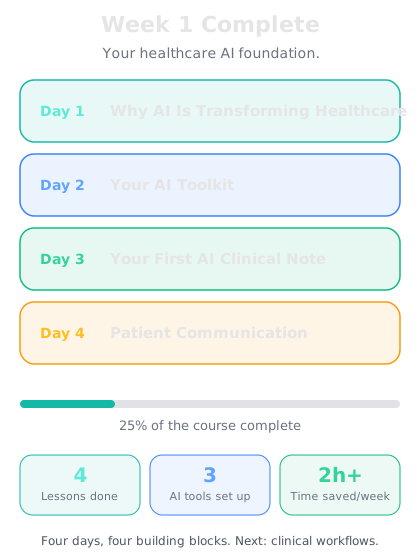
What you've built so far
Day 1 — The case for AI in healthcare. You saw the numbers: clinicians spend roughly two hours on documentation for every one hour of patient care. AI can cut admin time by 75% without sacrificing quality. AI is a co-pilot, not a replacement for clinical judgment.
Day 2 — Your AI toolkit. You set up ChatGPT (documentation workhorse), Claude (complex reasoning), and Perplexity (sourced research). Most importantly, you learned the golden rule: never enter real patient data into public AI tools. You adopted the template method — build prompts with fictional data, apply them in your secure EMR.
Day 3 — Your first AI clinical note. You drafted a complete SOAP note using a structured prompt template. You learned that structured input produces structured output, and that 30 extra seconds of prompt detail saves 10 minutes of editing. You customised the template for your specialty.
Day 4 — Patient communication. You created templates for after-visit summaries, appointment reminders, and test result notifications. You learned the readability principle — always specify a 6th grade reading level for patient-facing content. You practised handling sensitive communications with AI as scaffold and human empathy as the finish.
The three principles that matter most
Everything you've learned this week flows from three core principles. If you remember nothing else, remember these:
1. AI drafts, you decide. Every AI output is a first draft. You review it, refine it, and take clinical responsibility. AI doesn't practise medicine — you do.
2. Privacy is non-negotiable. No real patient data in public AI tools. Ever. Build templates with fictional cases, apply them inside your secure systems. This isn't optional — it's the foundation of ethical AI use in healthcare.
3. Structure in, quality out. The more organised your input, the better the output. A detailed, structured prompt produces a note that needs 60 seconds of review. A vague prompt produces something you'd spend longer fixing than writing from scratch.
Your checklist before moving on
Before you start next week's lessons, make sure you have:
- [ ] Three AI accounts active — ChatGPT, Claude, and Perplexity, all logged in and ready
- [ ] A Healthcare Templates document — with your saved SOAP note template and patient communication templates from days 3 and 4
- [ ] Used AI at least once in practice this week — even if it was just drafting one note or one patient email with fictional data. The first use is always the hardest. After that, it becomes second nature.
If you've checked all three boxes, you're ready for week 2. We're moving from basic documentation into the heavy-hitting clinical workflows — discharge summaries, referral letters, patient record summaries, triage support, and research. The time savings only get bigger from here.