How AI Credit Scoring Actually Works
You've probably sat in a meeting where someone said "the model scored it" as if that settled the matter. Today you build the mental model to know what that sentence actually means — and what questions it should trigger.
You don't need mathematics for this. You need a plain-English picture of how machine-learning scoring differs from the scorecards lending has used for decades, where the new power comes from, and where the new risks hide.
From five variables to hundreds of signals
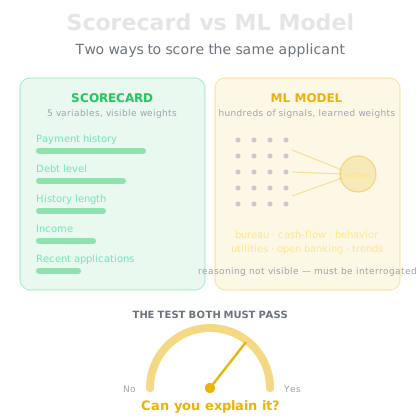
The traditional scorecard is something you could explain on a whiteboard. A handful of variables — payment history, outstanding debt, credit history length, income, recent applications — each assigned points. Add the points, compare to a cutoff, decide. Built by statisticians, reviewed by committees, understood by everyone. Its weakness is bluntness: two very different applicants can land on identical scores, and anyone without much credit history gets treated as a mystery.
A machine-learning model works differently. Instead of a person choosing five variables and their weights, the model is trained on thousands of historical outcomes — who repaid, who defaulted — and finds the patterns itself. It can weigh hundreds of signals at once, including interactions no analyst would think to test: not just "how much debt" but how balances move, how income and spending interact, how behavior trends over time.
The trade is straightforward to state: more predictive power, less transparency. A scorecard can be read; an ML model must be interrogated. Hold that thought — it becomes your job description shortly.
Alternative data and the thin-file applicant
Where do hundreds of signals come from? Increasingly, from alternative data — information beyond the traditional credit bureau file:
Cash-flow data — actual income and spending patterns from bank transactions, often the most direct read on affordability there is.
Utility, rent, and telecom payment history — years of on-time payments that never reached a bureau file.
Open banking data — where the customer consents to share account data, giving lenders a real-time picture instead of a months-old snapshot.
The most important consequence is for thin-file applicants — young people, new arrivals, cash-economy workers, anyone the traditional bureau barely knows. A scorecard sees them as a blank and blanks score badly. A model reading consented cash-flow data can see a person who has paid rent on time for five years and never missed a phone bill. Used well, alternative data doesn't just sharpen risk prediction — it extends fair access to credit to people the old system couldn't see.
Used well. Which brings us to the uncomfortable part.
More accurate does not mean fair
Here's the trap that catches smart institutions: a model can be highly accurate on average and still be systematically unfair to particular groups — without a single forbidden variable in it.
The mechanism is the proxy. Fair-lending rules everywhere prohibit deciding on characteristics like race, gender, or religion, so no serious model uses them. But an ML model hunting for predictive patterns can find variables that correlate with protected characteristics — postcode, shopping patterns, device type, even how someone fills in a form — and quietly reconstruct the discrimination through the back door. No one intended it. The training data reflected historical patterns, the model learned them, and the result discriminates anyway. Regulators judge outcomes, not intentions.
This is why creditworthiness scoring is treated as high-risk AI under rules like the EU AI Act, and why fair-lending scrutiny of models keeps rising in most jurisdictions. The specifics vary — always check your jurisdiction and lean on your compliance team — but the direction of travel is the same everywhere: lenders must test, monitor, document, and be able to explain.
Your job: interrogate, don't build
Relax on one point: nobody expects a credit officer to build models. Your institution buys them or has a modeling team. Your role — and increasingly, your regulatory duty — is to be the person who can question the model intelligently:
"What are the top factors driving this score?" Any serious model can produce reason codes or factor rankings. If nobody can show you them, that's your first finding.
"How was it tested for bias?" Ask what groups were tested, on what outcomes, and when it was last re-checked.
"What data is it using, and is it consented?" Especially for alternative data.
"When do humans override it — and how often?" A model nobody ever overrides is a model nobody is really supervising.
And here's where your everyday AI assistant earns its place: it's a superb translator between model-speak and plain English, as you're about to see.
The mental model, assembled
Scorecards you can read; ML models you must interrogate. Alternative data extends both power and access — and imports bias if nobody checks the proxies. Accuracy is not fairness, intent is not a defense, and the decision remains human at every step: the model scores, but a person approves, declines, and explains.
Tomorrow, we leave the theory behind and get you the daily win: AI-assisted application and affordability analysis.