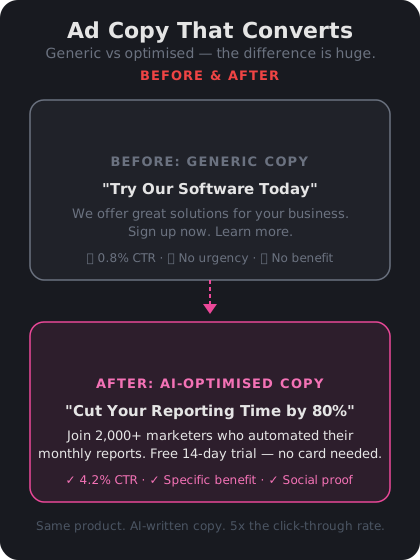
Great ad copy does three things: it grabs attention, communicates value, and drives action. AI will not magically make bad offers convert — but it will help you produce more variations faster so you can test your way to winning copy.
Today you will learn how to prompt AI for headlines, CTAs, benefit-driven body copy, and A/B test variants. The goal is not to accept the first output blindly. It is to generate a pool of strong options and refine the best ones.
Every converting ad has three components — a hook, a value statement, and a clear CTA.
The prompt framework for ad copy
The biggest mistake marketers make with AI is vague prompts like "Write me a Facebook ad." Instead, use this framework:
Product/Service: What you are selling, in one sentence.
Audience: Who you are targeting — demographics, pain points, desires.
Format: Headline + body + CTA, character limits, platform constraints.
Angle: The specific benefit or emotional trigger to lead with.
Here is the template: "Write a [platform] ad for [product] targeting [audience]. Lead with [angle]. Tone: [tone]. Include a headline under [X] characters, 2-3 sentences of body copy, and a CTA."
This gives AI the constraints it needs to produce usable output on the first try — not generic filler you have to rewrite from scratch.
Generating A/B test variants instantly
One of the most valuable uses of AI in ad copywriting is generating multiple variants for testing. Instead of agonizing over a single headline, ask for 10 and pick the best 3.
Try these prompting patterns:
- "Give me 10 headline variations for this ad. Mix emotional triggers: urgency, curiosity, social proof, and fear of missing out."
- "Rewrite this ad body copy in 3 tones: professional, conversational, and bold/edgy."
- "Create 5 CTA variations. Some should be direct ('Buy now'), some benefit-driven ('Start saving today'), and some curiosity-driven ('See what changed')."
The key insight: AI removes the bottleneck of variant creation. You can now test 5-10 variants per week instead of running the same ad for a month because writing new copy was too slow.
Knowledge Check
What is the most important element to include in an AI prompt for ad copy?
A
A request to make it go viral
B
A list of competitor ads to copy
C
The exact words you want the AI to use
D
Clear constraints — audience, tone, format, and the specific angle to lead with
Clear constraints give AI the context it needs to produce targeted, usable copy. Specifying your audience, tone, format, and angle eliminates generic output and gets you closer to final copy on the first draft.
🤖
ChatGPT
online
Write 3 Facebook ad variants for an online course teaching busy professionals to meal prep in 30 minutes. Target: working parents aged 30-45 who feel they never have time to cook healthy meals. Tone: empathetic but energizing.
**Variant A — Pain Point Lead:**
Headline: You Deserve Better Than Another Takeout Night
Body: You work hard all day. The last thing you need is an hour in the kitchen. Our 30-minute meal prep system helps busy parents feed their families healthy, delicious meals — without sacrificing their entire Sunday.
CTA: Start Your Free Trial →
**Variant B — Social Proof Lead:**
Headline: 12,000 Busy Parents Stopped Ordering Takeout
Body: They did not suddenly get more free time. They learned a system that turns 30 minutes into a full week of healthy meals. No chef skills needed. No complicated recipes. Just real food your family will actually eat.
CTA: See How It Works →
**Variant C — Curiosity Lead:**
Headline: What If Sunday Meal Prep Only Took 30 Minutes?
Body: Most meal prep guides assume you have 3 hours and a professional kitchen. Ours was built for parents with zero free time. Quick prep, simple ingredients, meals your kids will not push away.
CTA: Try the 30-Minute Method →
I would recommend A/B testing Variant A vs. C first — pain point vs. curiosity hooks typically produce the clearest winner.
↻ Replay conversation
Writing CTAs that actually drive clicks
The call-to-action is where most ads lose their audience. A weak CTA like "Learn More" leaves money on the table. Strong CTAs are specific, benefit-oriented, and low-friction.
Direct CTAs work when intent is high: "Buy Now," "Start Free Trial," "Book Your Call."
Benefit CTAs work for cold audiences: "Start Saving 10 Hours a Week," "Get Your Custom Plan," "See Your Results."
Curiosity CTAs work for awareness campaigns: "See What Changed," "Find Out Why," "Discover the Difference."
A practical rule: always test at least two CTA styles per campaign. The difference between "Sign Up" and "Start Your Free Plan" can be a 20-40% difference in click-through rate.
Knowledge Check
When generating ad copy variants with AI, what is the recommended approach?
A
Generate one perfect version and use it everywhere
B
Generate multiple variants with different emotional triggers and test them against each other
C
Only test headline changes, never body copy
D
Ask AI to copy a competitor's best ad
The power of AI in ad copy is speed of variant creation. Generating multiple versions with different hooks — urgency, curiosity, social proof — and testing them against each other lets you find winning copy through data, not guesswork.
Knowledge Check
Which type of CTA is best for a cold audience seeing your brand for the first time?
A
No CTA — let the audience decide on their own
B
A generic CTA like "Click Here"
C
A direct CTA like "Buy Now"
D
A benefit-driven CTA like "Start Saving 10 Hours a Week"
Cold audiences need to understand the benefit before they act. Benefit-driven CTAs like "Start Saving 10 Hours a Week" communicate value and reduce friction, while direct CTAs like "Buy Now" work better for warm audiences who already know your offer.
★
Your opinion matters!
How would you rate this lesson?
Not my thingLoved it!
What could be better?
✨
Thanks for your feedback!
It helps us make better lessons.
✍️
Day 3 Complete
"AI turns ad copywriting from a bottleneck into an assembly line. Use clear prompt constraints, generate multiple variants, and let A/B testing — not guesswork — pick the winner."
Tomorrow — Day 4
Social Media Content at Scale
Learn how to use AI to create platform-specific social media content, build content calendars, and batch-produce posts efficiently.