BlitzLearnAI
1 / 10
Day 2 of 14 · AI for Parents

AI 101 for Busy Parents

You don't need to understand engines to teach your kid to drive. But you absolutely need to know that cars can skid. Today you get the one mental model that explains both the magic and the failures of AI chatbots — in plain English, no math, no jargon.

By the end of this lesson you'll understand something most adults (and most kids) don't: why a chatbot can write a beautiful essay and still confidently invent a book that doesn't exist.

A chatbot is very, very good autocomplete

You know how your phone suggests the next word when you're typing? A chatbot like ChatGPT is that same idea, scaled up enormously. It was trained on a huge portion of the internet — books, articles, websites, conversations — and it learned one skill to superhuman level: predicting what words should come next.

That's it. That's the whole trick.

When it "answers" your question, it isn't looking up facts in a database. It's generating the most plausible-sounding continuation of your conversation, one word at a time. Because it absorbed patterns from millions of real explanations, the plausible answer is usually also the correct one. That's why it feels like talking to something that knows things.

But here's the part that matters for your family: producing plausible text is not the same as knowing. There's no fact-checker inside. There's no "I'd better not say this unless I'm sure." There's just prediction.

Knowledge Check
Does an AI chatbot "know" things the way a person does?
A
No — it predicts likely words based on patterns, which is often right but isn't the same as knowing
B
Yes — it has a built-in database of verified facts it looks up
C
Yes, but only for topics taught in school
D
No — it copies answers word-for-word from websites
A chatbot generates the most plausible next words based on patterns it absorbed during training. Because those patterns come from mostly-accurate sources, it's often right — but there's no internal fact-checking step. Plausible and true usually overlap. Usually.

Hallucinations — confident and wrong

When a chatbot doesn't have a good pattern to draw on, it doesn't say "I don't know." It does what it always does: it generates something plausible. A date that sounds right. A quote that sounds like the author. A citation formatted perfectly for a study that was never conducted.

This is called a hallucination, and here's the dangerous part: a hallucinated answer arrives in the exact same fluent, confident tone as a correct one. There's no stutter, no hedge, no warning label. Your kid cannot tell the difference by reading it — and neither can you.

Why does this matter for homework? Because the things kids most often ask AI for — dates, definitions, quotes, book summaries, sources — are exactly where hallucinations sneak into school reports looking completely legitimate.
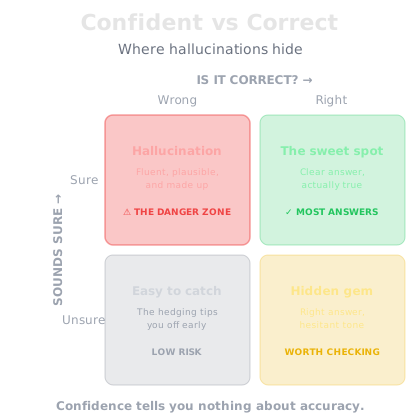
A two-by-two grid comparing how confident an AI answer sounds against whether it is actually correct, with the confident-but-wrong quadrant marked as the danger zone where hallucinations live
Hallucinations live in the confident-but-wrong quadrant — and the tone gives you zero warning, so verification has to.

Reading about hallucinations is one thing. Watching one happen is another. Here's a real-style demo you can repeat yourself tonight:

🤖
ChatGPT
online
Can you summarize the novel "The Silver Compass" by Margaret Hale? My daughter has a book report due Friday.
Of course! "The Silver Compass" by Margaret Hale follows Elena, a young cartographer's daughter in a coastal village, who discovers her late father's compass points not north but toward the things people have lost. As Elena follows it, she uncovers a family secret and must choose between restoring the past and protecting her village's future. Major themes include grief, memory, and the idea that what we search for shapes who we become. Would you like chapter-by-chapter notes for the report?
I made that book up. It doesn't exist. Neither does Margaret Hale.
You're right, and I apologize — I generated a summary for a book that doesn't exist. When given a plausible-sounding title and author, I produced the kind of text that usually follows such a request, rather than confirming the book was real. This is a good example of why AI answers about specific books, quotes, dates, and sources should always be verified against a real source before being used in schoolwork.
↻ Replay conversation
Final Check
Your child cites an AI answer in a school report. What's the right instinct?
A
Ban AI from schoolwork entirely — it can't be trusted for anything
B
Trust it — modern AI rarely gets things wrong
C
Ask the AI if it's sure — if it confirms, the answer is safe
D
Treat it as a starting point: verify names, dates, quotes, and sources against a real source before they go in
The intern rule: useful first draft, never the final authority. Facts that end up in schoolwork — especially names, dates, quotes, and citations — get checked against a real source. And "asking if it's sure" doesn't work: the same pattern-prediction that produced the error will often confidently defend it, or apologize even when it was right.

The rule your family needs

Here's tonight's dinner-table version of this entire lesson: treat AI like a brilliant intern. Astonishingly fast, tireless, great with words — and capable of confidently inventing things, so everything important gets double-checked before it ships.

Kids get this analogy instantly. It doesn't make AI scary, and it doesn't make it an oracle. It makes it what it actually is: a powerful tool with a known failure mode. Tomorrow, you finally get hands-on with it yourself.

🧠
Day 2 Complete
"AI is a brilliant intern, not an encyclopedia. Confident ≠ correct."
Tomorrow — Day 3
Your Parent AI Toolkit
Tomorrow you'll set up your own AI assistant in two minutes and put it to work on real parent tasks — starting tonight.
🔥1
1 day streak!