Day 4 of 14 · AI for Parents
Homework: Help or Cheating?
⏱ 7 min
📊 Beginner
This is the question every parent eventually asks: my kid used AI on their homework — is that cheating?
The honest answer: it depends entirely on how they used it. "Used AI" covers everything from asking for an explanation to submitting a machine-written essay under their own name. Treating those as the same thing is how parents end up either banning a genuinely useful tutor or shrugging at genuine cheating.
Today you'll learn to see the difference in seconds — and how to steer your kid toward the right side of the line.
The spectrum, not the switch
AI homework use isn't on or off. It's a spectrum, and every step shifts more of the thinking from your kid to the machine:
"Explain this concept to me" — Pure learning. The kid still does all the work; AI just replaces a confused hour with a clear explanation.
"Quiz me until I get it" — Also pure learning. AI as a patient practice partner. Teachers generally love this one.
"Check my work and tell me what's wrong" — Still healthy. The kid produced the work; AI plays the role of a tutor reviewing it.
"Improve my draft" — Now it's gray. Light feedback is fine. But if AI rewrites every sentence, whose writing is the teacher actually grading?
"Write it for me" — Over the line, almost everywhere. The kid learned nothing except how to paste a prompt.
Here's the key: the line isn't about the tool — it's about who did the thinking. Ask "what did my kid's brain do here?" and the answer usually gets obvious fast.
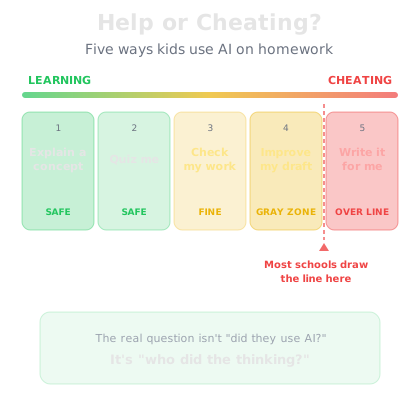
Memorize the question behind the spectrum: not "did they use AI?" but "who did the thinking?"
Knowledge Check
Which of these uses would most schools consider clearly fine?
A
Asking AI to quiz them on the material until they understand it
B
Pasting the assignment prompt and lightly editing the output
C
Having AI rewrite an essay so it "sounds better" before submitting
D
Submitting an AI-written draft with a few words changed
Getting quizzed keeps all the thinking on the student's side — AI is just a practice partner. The other three shift the actual work to the machine, which is where most schools (and most teachers' instincts) draw the line.
Same tool, opposite outcomes
Watch how differently the exact same chatbot behaves depending on what a student asks for. First the ghostwriter request — then the tutor request.
Write a 5 paragraph essay on why the Treaty of Versailles led to WW2. Make it sound like a 9th grader wrote it.
Here's a draft:
The Treaty of Versailles, signed in 1919, is often seen as a major cause of World War Two. It placed heavy blame and payments on Germany, which created anger and instability...
[essay continues for 5 paragraphs]
Want me to adjust the tone or length?
Actually wait. Don't write it for me. I have to write it myself. Can you quiz me on the Treaty of Versailles until I actually understand it? Don't give me answers unless I'm stuck.
Much better way to use me. Let's go:
**Question 1:** The treaty forced Germany to accept something called the "war guilt clause." What did it say, and why did ordinary Germans resent it so much?
Take your best shot — I'll tell you what you got right and what's missing, then we'll go deeper.
It said Germany had to take all the blame for the war? And they were angry because they didn't think it was only their fault
Solid — that's the core of it. ✅ Article 231 made Germany accept responsibility for the war, which justified the reparations bill.
What you're missing: the *economic* side. The reparations were set at a level Germany struggled to pay, which fed hyperinflation in 1923 and mass resentment.
**Question 2:** So how did that resentment help a fringe politician like Hitler gain support a decade later?
↻ Replay conversation
Find your school's actual line
Here's what surprises most parents: there is no universal school rule on AI. Policies vary wildly — by district, by school, sometimes by individual teacher. One classroom bans it outright; the one next door assigns homework that requires it. Assuming you know the policy is how kids get blindsided.
So do two things this week:
Check the written policy. Look in the student handbook, the syllabus, or the school portal for "AI," "academic integrity," or "unauthorized aid." If you can't find one, email the teacher and ask — it's a normal question now, not an awkward one.
Ask at parent-teacher night: "How do you want students using AI in your class — and where's your line?" Teachers appreciate the question, and your kid gets clarity instead of guesswork.
Then set the house rule that works regardless of policy: AI can explain, quiz, and give feedback — it doesn't produce work you put your name on. That rule survives any district's fine print.
Final Check
You discover your child pasted an essay prompt into ChatGPT and submitted the output as their own. What's the best response?
A
Ban AI tools entirely — clearly they can't be trusted with them
B
Let it go — schools haven't figured out AI rules anyway, so nothing really counts as cheating
C
Treat it as a learning problem: have them redo the work using AI only to explain and quiz, and agree on the "who did the thinking" rule going forward
D
Delete the chatbot app from their phone and monitor their browser history
A blanket ban pushes AI use underground and throws away a genuinely useful tutor; ignoring it teaches that shortcuts work. The response that sticks is redoing the assignment the right way — AI for explaining and quizzing, the kid for the actual thinking — with a clear rule for next time.
✏️
Day 4 Complete
"The question isn't 'did they use AI' — it's 'did they learn anything.'"
Tomorrow — Day 5
How to Talk to Your Kids About AI
Tomorrow you'll get conversation starters and scripts by age band — so the AI talk feels like curiosity, not interrogation.