Credit Control Is Ripe for AI
Look at your aged debtors report right now. Every line on it is money your business has already earned — goods shipped, services delivered, invoices raised. And it's sitting in other people's bank accounts.
Credit control is the job of going and getting it back. And here's the thing most people miss: the work itself is mostly chasing, checking, and drafting. Writing reminder emails. Reading credit reports. Summarizing ledgers. Deciding who to call first. That is exactly the kind of work AI compresses from hours into minutes — which is why credit control is one of the most AI-ready jobs in the whole finance function.
What slow receivables actually cost
When invoices get paid late, three things quietly drain your business:
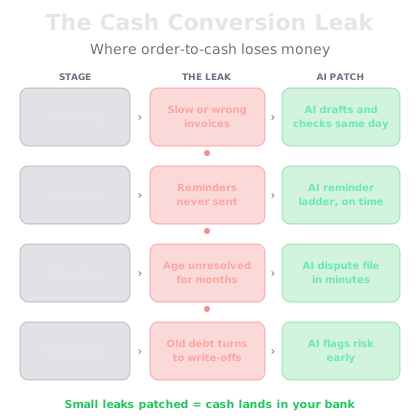
Cash gets tied up. Money stuck in receivables is money you can't use to pay suppliers, buy stock, or cover payroll. Businesses that are profitable on paper can still fail because the cash arrives too slowly.
Write-offs creep in. The longer an invoice ages, the harder it typically becomes to collect. An account that's slipped past ninety days is a very different animal from one that's a week late — and every eventual write-off comes straight off your bottom line.
The awkward-chaser problem. Most people hate chasing money. It feels confrontational, so the reminder email gets postponed, softened, or never sent. Meanwhile the customer — who often pays whoever asks most clearly and most persistently — pays someone else first.
None of this gets fixed by working harder. It gets fixed by chasing consistently, checking customers properly, and getting the paperwork right — and AI makes all three dramatically faster.
A credit controller's week — with and without AI
Without AI: Monday morning disappears into the aged debtors report, scanning hundreds of lines and guessing who to chase. Each reminder email is written from scratch — or worse, postponed because finding the right firm-but-polite wording is draining. A new customer wants credit terms, so an hour goes into reading their filed accounts and a credit report. By Friday, half the planned chasers were never sent, and the riskiest account got the same gentle nudge as everyone else.
With AI: You paste an anonymized ledger extract into your AI assistant and get a summary of the biggest risks and a suggested chase order in minutes. The reminder ladder — friendly nudge, firm follow-up, formal warning — is drafted in your voice; you review, personalize, and send. The new customer's credit report becomes a one-page risk snapshot you can actually act on. The judgment is still yours. The grind isn't.
That's the whole model of this course: AI does the reading, ranking, and drafting. You make every decision — every credit limit, every escalation, every send.
Where the next 14 days take you
Here's the roadmap. Days 1–5 cover the foundations: your AI toolkit and data-hygiene rules, AI-assisted credit checks, setting limits that fit, and getting applications and terms right before the first invoice. Days 6–10 are the collection engine: invoice hygiene, prioritizing who to chase, dunning emails that get paid, payment plans, and resolving disputes fast. Days 11–14 go up a level: spotting insolvency red flags early, DSO reporting and cash forecasting, and assembling your personal credit control playbook.
Every lesson gives you prompts you can use the same day — with synthetic examples, so you learn the technique without ever exposing real customer data.
One rule before we start, and it applies to every single lesson: AI assists, humans decide. No credit limit gets approved, no email gets sent, and no account gets escalated without a human — you — making the call.
Your one action today
Open your aged debtors report and answer one question honestly: which three accounts worry you most, and when did you last chase each one? If the answer is "I'm not sure" or "not recently," you've just found the gap this course closes.
Tomorrow: your toolkit. Which AI assistant to use, the confidentiality rules for customer financial data, and three prompts that pay for the setup time immediately.