What Is AI and Why Does It Need Governance?
Welcome to the AIGP Certification Prep course. Over the next 30 days, you'll master every domain tested on the IAPP AI Governance Professional exam — one focused lesson at a time.
Today we start with the most fundamental question: what is AI, and why does it need its own governance framework?
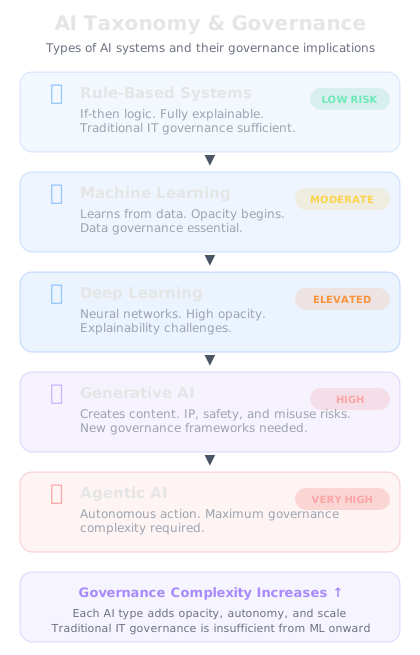
Defining AI for Governance Professionals
For the AIGP exam, you need to know the generally accepted definitions of AI and its subtypes:
Artificial Intelligence (AI) — A broad field of computer science focused on creating systems that can perform tasks typically requiring human intelligence: reasoning, learning, perception, and decision-making.
Machine Learning (ML) — A subset of AI where systems learn patterns from data rather than following explicit rules. This includes supervised learning, unsupervised learning, and reinforcement learning.
Deep Learning — A subset of ML using neural networks with many layers. Powers image recognition, natural language processing, and most modern AI breakthroughs.
Generative AI — AI systems that create new content: text, images, code, audio, or video. Think ChatGPT, Claude, Midjourney, and DALL-E.
Foundation Models — Large models trained on broad data that can be adapted for many tasks. GPT-4, Claude, and Gemini are foundation models.
Agentic AI — AI systems that can autonomously plan, use tools, and take actions to accomplish goals with minimal human intervention.
Why Traditional IT Governance Falls Short
If your organization already has IT governance, data governance, and cybersecurity frameworks — why do you need AI governance?
Because AI introduces characteristics that existing frameworks weren't designed to handle:
Opacity — Many AI models are "black boxes." Unlike traditional software where you can trace every decision through code, a deep learning model may make decisions that even its creators can't fully explain.
Autonomy — AI systems can make decisions and take actions without human intervention. A chatbot might provide medical advice it was never designed to give. An autonomous vehicle makes split-second choices about safety.
Scale — AI can process millions of decisions per second. A biased hiring algorithm doesn't discriminate against one person — it can systematically exclude thousands before anyone notices.
Emergent behavior — AI systems can exhibit capabilities or behaviors that weren't explicitly programmed or anticipated during development.
Data dependency — AI systems are only as good (and as biased) as their training data. Garbage in, governance problems out.
Narrow AI vs. General AI
For the exam, understand this distinction clearly:
Narrow AI (ANI) — AI designed for a specific task. Every AI system deployed today is narrow AI: spam filters, recommendation engines, medical imaging analysis, ChatGPT (yes, even generative AI is narrow — it's designed for language tasks).
Artificial General Intelligence (AGI) — A hypothetical AI with human-level reasoning across all domains. AGI does not exist today. But governance discussions must consider its potential implications.
The AIGP exam focuses on governing narrow AI — because that's what organizations are actually deploying. However, you should understand how foundation models blur the line, since they can perform many different tasks despite technically being narrow AI.
The Governance Imperative
AI is being deployed faster than organizations can build governance around it. Consider:
Speed of deployment — A team can integrate a generative AI API into a production application in hours. Building governance policies for that integration takes weeks or months.
Regulatory acceleration — The EU AI Act is now law. AI-specific regulations are proliferating globally. Organizations without governance frameworks face compliance risk.
Reputational stakes — Every week brings a new headline about AI bias, privacy violations, or safety failures. Organizations need governance to prevent becoming the next cautionary tale.
Board-level attention — AI governance is now a boardroom topic. Directors are asking: "What's our AI governance program?" If the answer is "we don't have one," that's a material risk.
Real-World Scenario
In March 2023, the Italian Data Protection Authority (Garante) temporarily banned ChatGPT, citing GDPR violations including the lack of a lawful basis for processing personal data used to train the model, the absence of age verification mechanisms, and insufficient transparency about how user data was collected and used. OpenAI was given 20 days to address the concerns or face a fine of up to 20 million euros. The ban was lifted in April 2023 after OpenAI implemented changes including an age gate, updated privacy disclosures, and an opt-out mechanism for EU users.
This incident illustrates exactly why AI needs its own governance framework. Traditional IT governance would not have anticipated the unique challenges posed by a large language model trained on broad internet data — issues like data provenance for training sets, the opacity of model behavior, and the scale at which a single AI system can affect millions of users across jurisdictions. Italy's action prompted other European regulators to open their own investigations, demonstrating how AI governance gaps in one jurisdiction can cascade globally.
For the AIGP exam, this case is a powerful example of what happens when AI deployment outpaces governance. OpenAI had robust IT infrastructure governance but lacked the AI-specific governance controls — transparency mechanisms, lawful basis documentation, and data subject rights processes — that regulators expected.
Go Deeper
Want to see these concepts applied to full case studies? Check out AIGP Scenarios — 10 real-world governance simulations mapped to the AIGP exam domains.