Reading Financial Statements with AI
Financial statements tell a story — but reading that story quickly across a balance sheet, income statement, and cash flow statement takes experience and time. AI can accelerate both.
Today you'll learn how to feed complete financial statements into AI and extract key ratios, spot trends across periods, identify red flags, and generate executive-level summaries. Whether you're reviewing a client's accounts, preparing for a board meeting, or performing due diligence on an acquisition target, this skill will save you hours every week.
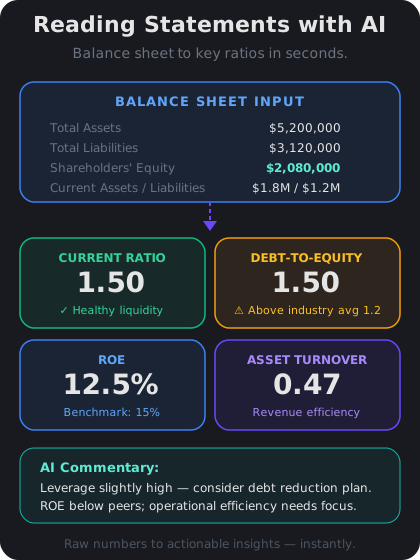
What AI can extract from financial statements
When you paste a set of financial statements into AI, you can ask it to do any of the following in seconds:
Calculate key ratios — Current ratio, quick ratio, debt-to-equity, return on equity, gross margin, operating margin, interest cover. Instead of building a ratio spreadsheet, you get instant calculations.
Compare periods — "Compare FY2024 to FY2023 and highlight the three most significant changes." AI spots movements that might take you twenty minutes of scanning.
Flag anomalies — "Are there any line items that look unusual or warrant further investigation?" AI can identify sudden jumps, inconsistencies between statements, or ratios that fall outside normal ranges.
Generate summaries — "Write a two-paragraph executive summary of this company's financial position suitable for a credit committee." Instant drafts that you refine with your professional insight.
Explain in plain language — "Explain this balance sheet to a non-financial stakeholder." Perfect for client meetings, board presentations, or training junior staff.
How to structure your financial statement prompts
The CRAF method from yesterday works perfectly here. But financial statements have additional considerations:
Include all three statements — The balance sheet, income statement, and cash flow statement are interconnected. If you only provide one, AI can only give you a partial picture. Whenever possible, paste all three.
Specify the accounting framework — "These statements are prepared under IFRS" or "under UK GAAP" or "under US GAAP." This affects how AI interprets certain line items.
State the industry — A current ratio of 0.8 might be alarming for a manufacturer but normal for a supermarket chain. Industry context changes the interpretation.
Ask for specific ratios — Don't just say "analyse this." Say "calculate the current ratio, quick ratio, debt-to-equity, interest cover, and return on capital employed." Specificity drives quality.
Building a ratio dashboard with AI
Here's a powerful technique: ask AI to build you a ratio dashboard template that you can reuse every month or quarter.
Prompt: "Create a financial ratio dashboard template with the following sections: Liquidity (current ratio, quick ratio, cash ratio), Profitability (gross margin, operating margin, net margin, ROE, ROCE), Leverage (debt-to-equity, interest cover, gearing ratio), Efficiency (debtor days, creditor days, inventory turnover, cash conversion cycle). For each ratio, include the formula, what 'good' looks like for a mid-size UK manufacturer, and a RAG rating threshold."
AI will generate a comprehensive template that you can paste into Excel or Google Sheets. Then each period, you simply paste the new numbers and ask AI to update the commentary.
This is the kind of task that would take an hour to build from scratch but takes five minutes with AI — and the output is often more thorough because AI doesn't forget ratios.
Limitations to watch for
AI is powerful for financial statement analysis, but it has important limitations:
It can't verify the numbers. AI takes whatever you give it at face value. If the statements contain errors, AI will analyse the errors as if they were correct. Always ensure your source data is accurate.
It doesn't know off-balance-sheet items. Operating leases (pre-IFRS 16), contingent liabilities, commitments — these affect the real financial position but might not appear in the numbers you paste. Mention them in your prompt if relevant.
It may not catch sophisticated manipulation. Revenue recognition games, channel stuffing, or aggressive capitalisation policies require forensic accounting skills. AI can flag obvious anomalies but won't catch everything a trained auditor would.
It can hallucinate ratios. Always verify the maths. AI occasionally makes arithmetic errors, especially with complex multi-step calculations. A quick sense-check saves embarrassment.