Why AI Is Transforming Finance
Finance has always demanded precision, judgement, and trust. None of that is changing. What is changing is everything surrounding those core skills — the data entry, the report formatting, the variance commentary, the reconciliation grunt work, the tax research.
AI doesn't replace the professional scepticism you bring to an audit or the strategic insight behind a CFO's capital allocation decision. It replaces the four hours you spend writing month-end commentary when you could be advising clients or spotting risks. Today you'll see exactly how AI is reshaping finance — and why the professionals who adopt it now will have a significant edge.
The time trap every finance professional knows
Think about your average month-end close. How much of it is spent on tasks that a machine could handle?
Writing variance commentary — You already know revenue is down 8% because a major client delayed their order. But translating that into board-ready language across 15 cost centres takes hours. Every. Single. Month.
Reconciling accounts — Matching bank transactions to GL entries, chasing unreconciled items, formatting the reconciliation for review. It's essential work, but it's mechanical.
Building reports — Pulling data from multiple systems, formatting tables, adding charts, writing executive summaries. A single management pack can consume an entire day.
Researching tax treatments — Is this lease capitalised under IFRS 16? What's the CGT position on this disposal? You know where to look, but the looking still takes time.
Two analysts, same month-end deadline
Let's compare two financial analysts closing the books for January.
Analyst A (no AI):
- 3 hours writing variance commentary for 12 cost centres
- 2 hours formatting the management report pack
- 1.5 hours drafting the CFO's executive summary
- 1 hour researching an unusual accounting treatment
- Total: ~7.5 hours
Analyst B (with AI):
- 30 minutes pasting actuals vs budget into ChatGPT and refining variance commentary
- 20 minutes generating formatted report sections
- 15 minutes producing an executive summary draft
- 15 minutes getting a first-pass answer on the accounting treatment, then verifying
- 30 minutes reviewing and adjusting everything with professional judgement
- Total: ~1.5 hours
Same rigour. Same sign-off standards. One-fifth of the time. That extra six hours goes back into analysis, advisory work, or simply leaving the office before midnight during close week.
What AI can do for finance right now
This isn't a five-year roadmap. These are things you can do today with free AI tools:
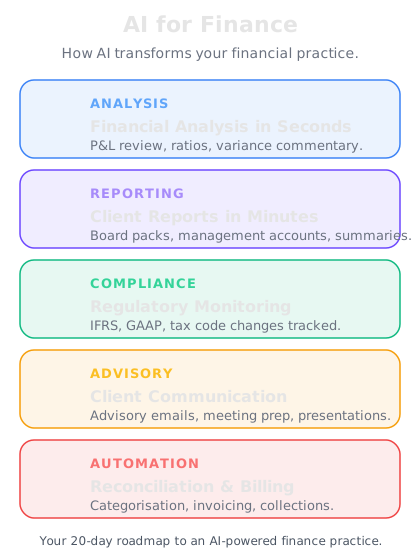
Write variance commentary in seconds — Paste your actuals vs budget table and get clear, professional explanations of every material variance. Adjust the tone for board packs, team meetings, or investor updates.
Analyse financial statements — Feed in a P&L, balance sheet, or cash flow statement and ask AI to calculate key ratios, spot trends, and flag anomalies.
Draft client communications — Engagement letters, advisory memos, tax planning summaries, audit findings. Describe the situation, get a polished draft back.
Research accounting standards — Ask about IFRS treatments, GAAP differences, or tax code provisions. AI gives you a solid starting point that you verify against authoritative sources.
Categorise transactions — Paste a bank feed export and get intelligent categorisation suggestions based on descriptions, amounts, and patterns.
What you'll build in this course
Here's a preview of what's coming over the next 20 days:
Week 1 (Days 1-5): Foundations — Set up your AI toolkit, run your first financial analysis, read financial statements with AI, and build a solid foundation for everything ahead.
Week 2 (Days 6-10): Core Finance Workflows — Automate expense categorisation, build cash flow forecasts, create AI-powered budgets, research tax questions, and prepare for audits.
Week 3 (Days 11-15): Reporting and Communication — Generate client reports, board packs, investor summaries, and regulatory filings with AI assistance.
Week 4 (Days 16-20): Advanced Strategy — Model scenarios, build financial dashboards, detect fraud patterns, and create your long-term AI finance workflow.
Every lesson is practical. Every lesson gives you something you can use that day in your real work.