Day 4 of 20 · AI for Healthcare
Patient Communication
⏱ 5 min
📊 Beginner
Patients don't just want good care — they want to understand their care. But writing clear, empathetic patient communications takes time that most clinicians don't have. The result? Rushed after-visit summaries, jargon-heavy discharge instructions, and follow-up messages that never get sent.
Today you'll use AI to draft patient-friendly emails, follow-up instructions, and appointment reminders in minutes. The goal is communication that's warm, clear, and written at a reading level your patients can actually understand.
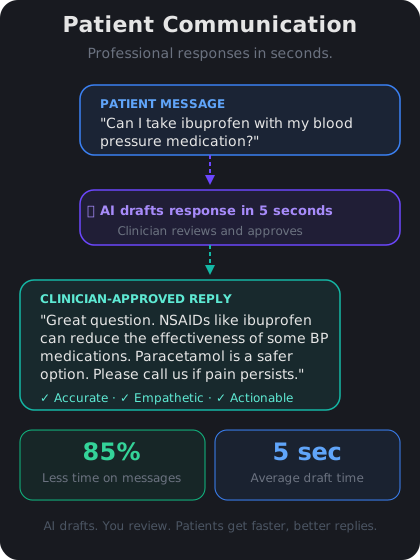
Clear patient communication improves adherence, reduces call-backs, and builds trust — AI helps you write it in seconds.
Why patient communication matters more than you think
Poor communication isn't just inconvenient — it's dangerous. Research shows that 40-80% of medical information provided during visits is immediately forgotten, and nearly half of what is remembered is recalled incorrectly.
Written follow-up bridges that gap. Patients who receive clear, written instructions after a visit have significantly better medication adherence, fewer unnecessary ER visits, and higher satisfaction scores.
The problem isn't that clinicians don't want to send good follow-ups. It's that writing a thoughtful, jargon-free summary for every patient is another 5-10 minutes you don't have. AI changes that equation completely.
The readability principle
Medical professionals write at a medical level. That's natural — it's how you were trained. But the average adult in the US reads at a 7th-8th grade level, and health literacy is even lower.
When you ask AI to draft patient communications, always include a readability instruction:
- "Write at a 6th grade reading level"
- "Use plain language, no medical jargon"
- "Explain any medical terms in simple words"
- "Use short sentences and bullet points"
This single instruction transforms your patient communications from clinical letters into documents that actually help people understand their health.
I need to send a follow-up email to a patient who was just diagnosed with type 2 diabetes. She's starting metformin 500mg twice daily, needs to schedule a dietitian appointment, and has a follow-up blood test in 3 months. Write a warm, clear email at a 6th grade reading level. No medical jargon.
**Subject: Your Visit Summary & Next Steps**
Hi [Patient Name],
Thank you for coming in today. I wanted to send you a summary of what we talked about so you have everything in one place.
**Your diagnosis:**
Your blood tests show that your blood sugar levels are higher than normal. This is called type 2 diabetes. It's a very common condition, and the good news is that it can be managed well with the right steps.
**Your new medication:**
- **Metformin 500 mg** — take one tablet twice a day, with breakfast and dinner
- Take it with food to avoid an upset stomach
- It may take a few weeks to notice the full effect
- If you have any side effects like nausea or diarrhoea, let us know — these often improve with time
**Your next steps:**
1. **Schedule a dietitian appointment** — call our front desk at [phone number] to book this. A dietitian will help you build an eating plan that works for your life.
2. **Blood test in 3 months** — we'll recheck your blood sugar levels to see how the medication is working. You'll get a reminder before then.
3. **Keep moving** — even 20-30 minutes of walking most days makes a real difference.
You're not alone in this. We're here to support you every step of the way. If you have any questions before your next visit, don't hesitate to reach out.
Warm regards,
[Your Name]
↻ Replay conversation
Knowledge Check
Why should you include a readability instruction when asking AI to draft patient communications?
A
Because AI defaults to informal language that may seem unprofessional without guidance
B
Because readability instructions reduce the chance of AI hallucinating medical facts
C
Because medical professionals naturally write at a level above most patients' health literacy
D
Because AI cannot generate medical terminology without explicit permission
Clinicians are trained to write and think in medical language. Without a readability instruction, AI mirrors that level of complexity. Specifying a 6th grade reading level ensures the output is accessible to the majority of patients, improving comprehension and adherence.
Templates for common patient communications
Here are three prompt templates you can save and reuse. Fill in the bracketed fields for each patient.
Template 1 — After-Visit Summary:
"Write a patient-friendly after-visit summary. Patient saw [specialty] for [reason]. Key findings: [summary]. Plan: [medications, tests, follow-up]. Write at a 6th grade reading level. Warm, reassuring tone. Include next steps as a numbered list."
Template 2 — Appointment Reminder:
"Write a friendly appointment reminder for [patient type] scheduled on [date] at [time] for [reason]. Include: what to bring, how to prepare (e.g., fasting), and the clinic address. Keep it brief and clear."
Template 3 — Test Results (Normal):
"Write a brief, reassuring message to a patient letting them know their [test name] results came back normal. Explain what was tested in simple terms. Include when their next check-up is scheduled. Warm tone, 6th grade reading level."
Save these in your Healthcare Templates document. You'll use them again and again.
Knowledge Check
What percentage of medical information provided during visits is immediately forgotten by patients?
Research consistently shows that patients forget 40-80% of medical information provided during visits, and nearly half of what they do remember is recalled incorrectly. This is why written follow-up communication is so important — it gives patients a reliable reference they can return to.
Handling sensitive communications with care
Not every patient message is a routine follow-up. Some require extra sensitivity:
Abnormal results: Ask AI to draft with empathy and clarity. Specify: "Compassionate tone. Explain what the result means, what happens next, and reassure the patient that a plan is in place."
Mental health follow-ups: Specify: "Validating, non-judgmental tone. Avoid clinical labels. Focus on support and next steps."
End-of-life or palliative care: These often need a human touch that AI can't fully replicate. Use AI for the structural draft, but rewrite the emotional core yourself.
The rule of thumb: the more emotionally charged the communication, the more human editing it needs. AI gives you the scaffold. You add the heart.
Knowledge Check
For which type of patient communication should you rely most heavily on personal editing rather than AI output?
A
Medication refill confirmations
B
Routine appointment reminders
C
Sensitive communications like end-of-life care discussions
D
Normal lab result notifications
Emotionally sensitive communications require a human touch that AI cannot fully replicate. For end-of-life discussions, mental health follow-ups, and difficult diagnoses, use AI for the structural draft but invest time in personal editing to ensure the tone is genuinely compassionate and appropriate.
💬
Day 4 Complete
"Clear patient communication saves lives — literally. AI drafts it in seconds, you add the personal touch, and your patients leave with instructions they can actually understand. Save those three templates today."
Tomorrow — Day 5
Week 1 Recap
Tomorrow you'll review everything you've built in days 1-4 and solidify your AI-powered healthcare workflow before moving to advanced techniques.