Your First AI Clinical Note
Documentation is the single biggest time sink in clinical practice. Today, you're going to change that. By the end of this lesson, you'll have drafted a complete SOAP note using AI — and you'll have a reusable prompt template you can adapt for every patient encounter going forward.
We're using the template method from yesterday: fictional patient data in AI, real workflows in your EMR. Let's build your first clinical note together.
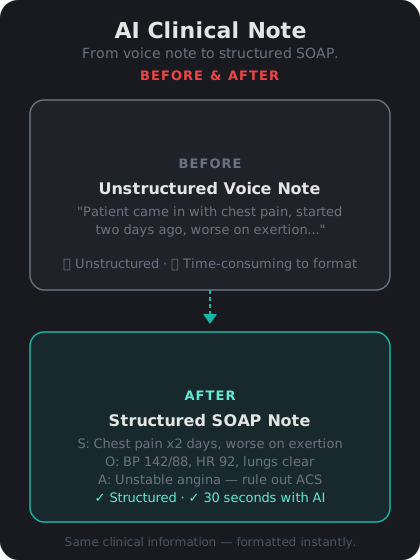
The anatomy of a great SOAP note prompt
A mediocre prompt gives you a mediocre note. A structured prompt gives you a note that's nearly ready to sign. The difference comes down to what you include.
Essential elements for your prompt:
- Patient demographics (age, sex, relevant history)
- Chief complaint and HPI (history of present illness)
- Vitals and key exam findings
- Any labs or imaging results
- Your clinical assessment
- Your intended plan
Format instructions that make a difference:
- Specify "SOAP format" explicitly
- Ask for "concise medical language"
- Request ICD-10 codes if your practice uses them
- Specify any section requirements unique to your specialty
The more structured your input, the less editing you'll need on the output. Think of it as a trade: 30 extra seconds of structured input saves you 5 minutes of editing.
Building your SOAP note prompt — step by step
Let's walk through a realistic clinical scenario. Imagine you've just finished seeing a patient in your morning clinic.
The scenario: A 45-year-old female presents with a 3-week history of progressive fatigue and unintentional weight gain of 4kg. She has a history of depression managed with sertraline. Vitals are normal except HR 58. Exam shows dry skin, mild periorbital oedema, and delayed ankle reflexes. You suspect hypothyroidism and order thyroid function tests.
Here's how to structure your prompt:
Bad prompt: "Write a SOAP note for a tired patient with weight gain."
Good prompt: "Write a SOAP note for a 45-year-old female presenting with 3 weeks of fatigue and 4kg unintentional weight gain. PMH: depression on sertraline 50mg. Vitals: BP 118/76, HR 58, Temp 36.4. Exam: dry skin, mild periorbital oedema, delayed ankle reflexes bilaterally. Assessment: suspected hypothyroidism. Plan: TSH and free T4, lipid panel, CBC. Follow-up in 1 week for results. Use concise medical language, SOAP format."
The difference is night and day. Let's see what ChatGPT produces with the good prompt.
Customising your template for your specialty
The SOAP format works across most specialties, but you'll want to customise your prompt template for your specific practice. Here are quick adaptations:
Primary care / Internal medicine: Add a "Health Maintenance" section to your prompt — ask AI to include preventive care reminders relevant to the patient's age and risk factors.
Emergency medicine: Replace the structured plan with "Disposition" — include discharge instructions or admission rationale. Ask for a higher tempo, more concise language.
Psychiatry: Expand the Subjective section — ask for a mental status exam (MSE) format in the Objective section instead of a physical exam.
Surgery: Add a "Pre-operative" or "Post-operative" framing. Ask for specific wound descriptions, drain outputs, and surgical follow-up milestones.
Paediatrics: Include developmental milestones and growth parameters. Ask for family-centred language in any patient-facing summaries.
The template from today's chat demo works for general use. Adapt it to your specialty and save it in your Healthcare Templates document.
Your workflow from today forward
Here's the three-minute clinical note workflow you just learned:
1. During the encounter — Focus on the patient. Jot down key findings on your usual scratch method (mental notes, paper, structured template in your EMR).
2. After the encounter — Open your saved SOAP prompt template. Fill in the bracketed fields with the encounter details. Paste into AI (using de-identified data) or into your EMR's AI assistant if available.
3. Review in 60 seconds — Read the output. Check for accuracy, hallucinations, and completeness. Add your clinical nuance. Sign.
That's it. Three to five minutes per note instead of twelve to fifteen. Over a 20-patient clinic day, that's two to three hours saved. Every single day.
Tomorrow we're taking this same efficiency to patient communication — emails, follow-up instructions, and appointment reminders that used to eat your lunch break.