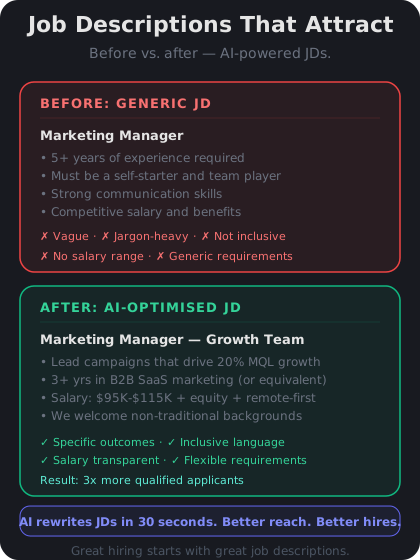
A job description is your first conversation with a candidate. Most JDs are terrible — they're bloated with jargon, packed with unrealistic requirements, and written in a tone that repels more people than they attract. AI can fix this. Today you'll learn how to use AI to write job descriptions that are clear, inclusive, and compelling enough to bring in the right candidates.
The difference between a good JD and a bad one can mean 3x more qualified applicants. That's not an exaggeration — it's what HR teams consistently report after rewriting their postings with AI.
AI helps you cut the jargon, split requirements from nice-to-haves, and use inclusive language.
Requirements vs nice-to-haves
The most common mistake in job descriptions is listing nice-to-haves as requirements. When you write "must have 7+ years of experience" but the role could be done by someone with 4 years, you're eliminating strong candidates — especially women and underrepresented groups who tend to self-select out when they don't meet every listed requirement.
Use AI to separate them. Paste your draft JD and prompt: "Separate these qualifications into must-have requirements and nice-to-have preferences. Be strict — only list something as required if the person literally cannot do the job without it."
The rule of thumb: If someone could learn it in the first 90 days, it's a nice-to-have, not a requirement.
Must-haves should be 4-6 items maximum. Nice-to-haves can be longer, but frame them as "bonus points" or "you'll stand out if you have" — language that encourages rather than discourages.
Knowledge Check
Why is it important to separate requirements from nice-to-haves in a job description?
A
Because listing nice-to-haves as requirements discourages qualified candidates from applying
B
Because job boards penalize listings with too many requirements
C
Because legal regulations require a maximum of 5 requirements per listing
D
Because AI tools cannot process job descriptions with more than 10 qualifications
Research consistently shows that candidates — especially women and underrepresented groups — self-select out when they don't meet every listed requirement. Separating true requirements from nice-to-haves increases your applicant pool with qualified people.
Writing inclusive language with AI
Inclusive language in job descriptions isn't just about being politically correct — it directly affects who applies. Words like "rockstar," "ninja," "aggressive," and "dominant" have been shown to discourage women and non-binary candidates from applying. Phrases like "young and energetic" can signal age discrimination.
Prompt AI to audit your language: "Review this job description for gendered language, age-biased terms, ability-biased language, and cultural assumptions. Suggest neutral alternatives for any issues you find."
- "Must be a native English speaker" becomes "strong English communication skills"
- "Young and dynamic team" becomes "collaborative and energetic team"
- "Man the front desk" becomes "staff the front desk"
Make this a standard step in your JD workflow. Every description gets an inclusivity review before posting.
Knowledge Check
Which phrase in a job description could discourage diverse candidates from applying?
A
"Strong communication skills required"
B
"Experience with project management tools preferred"
C
"We're looking for a rockstar who thrives in an aggressive, fast-paced environment"
D
"Collaborative team player with attention to detail"
Words like "rockstar" and "aggressive" have been shown to discourage women and non-binary candidates from applying. Neutral alternatives like "skilled professional" and "fast-paced" are more inclusive without losing meaning.
🤖
ChatGPT
online
Write a job description for a People Operations Manager at a 150-person remote-first SaaS company. The role reports to the VP of People. Focus on inclusive language and separate requirements from nice-to-haves.
**People Operations Manager**
*Location: Remote (US time zones) | Reports to: VP of People*
We're looking for a People Operations Manager to build and improve the systems that support our 150-person team. You'll own the employee lifecycle from onboarding through offboarding, manage our HRIS, and partner with managers to create a workplace where people do their best work.
**What you'll do:**
- Design and run onboarding programs for new hires
- Manage and optimize our HRIS and people data
- Build scalable processes for performance reviews, compensation cycles, and employee engagement
- Partner with managers on people-related questions and challenges
- Ensure compliance with employment regulations across states where we operate
**Requirements:**
- 3+ years in people operations or HR generalist roles
- Experience managing an HRIS platform
- Strong written communication skills
- Knowledge of US employment law fundamentals
**Nice-to-have:**
- Experience at a remote-first company
- Familiarity with tools like Rippling, Lattice, or Culture Amp
- Background in building people programs from scratch
- Experience supporting international employees
↻ Replay conversation
Knowledge Check
What is the best way to use AI for job description writing?
A
Copy a competitor's JD and ask AI to change the company name
B
Use AI only for spell-checking the final version
C
Let AI write the entire JD from scratch without any input
D
Provide AI with role context and requirements, then have it draft, audit for inclusivity, and separate must-haves from nice-to-haves
The most effective approach combines your knowledge of the role with AI's drafting and auditing capabilities. Give AI the context — role, team, company — and let it draft, check for inclusive language, and structure requirements properly.
★
Your opinion matters!
How would you rate this lesson?
Not my thingLoved it!
What could be better?
✨
Thanks for your feedback!
It helps us make better lessons.
👥
Day 3 Complete
"Great job descriptions are clear, inclusive, and honest about what's required vs what's a bonus — AI helps you nail all three."
Tomorrow — Day 4
Screening & Shortlisting with AI
Learn how to use AI to screen resumes efficiently, build shortlisting frameworks, and guard against bias in your hiring process.