Why AI Changes Product Development
Most products fail. Not because the idea was bad, but because the research was. The founders guessed instead of validated, assumed instead of tested, and spent six months building something nobody asked for.
The traditional product development cycle — research, validate, prototype, test, launch — used to take 12 to 18 months for a single product. AI compresses that into weeks. Not by cutting corners, but by doing the grunt work of analysis, synthesis, and pattern-matching at a speed no human team can match.
Today you'll learn why AI fundamentally changes how products go from idea to market — and why teams that ignore this shift are already falling behind.
The old way vs the AI way
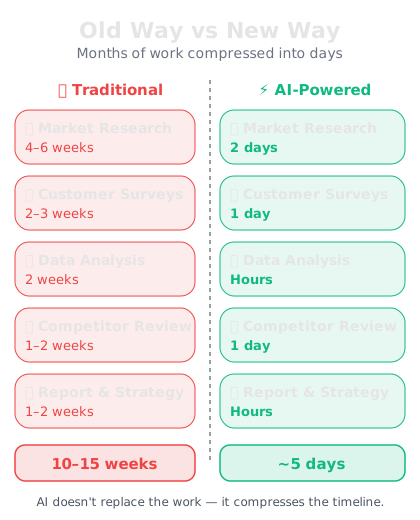
Product development has always been expensive because information is expensive. Market research reports cost thousands. Customer interviews take weeks to schedule. Competitive analysis means manually scouring dozens of websites, reading hundreds of reviews, and trying to spot patterns in spreadsheets.
The old way:
- Commission a market research report (£5,000–£25,000, 4–8 weeks)
- Run focus groups to test assumptions (£3,000–£10,000, 2–4 weeks)
- Manually analyse competitor products one by one (days of scrolling)
- Build a prototype based on gut feeling and limited data
- Launch and hope the market agrees with your assumptions
The AI way:
- Ask Perplexity to synthesise market data from dozens of sources in minutes
- Use ChatGPT to simulate customer personas and stress-test your assumptions
- Have Claude analyse 200 competitor reviews and extract the top 10 unmet needs
- Build a prototype informed by real data patterns, not hunches
- Launch with confidence because you've already validated demand
The difference isn't marginal. It's transformational. A solo founder with AI can now do market research that used to require a team of analysts.
Why most products fail — and it's not what you think
Let's look at the data. CB Insights analysed over 100 startup post-mortems and found that the number one reason products fail is "no market need" — 42% of the time. Not funding. Not competition. Not timing. Simply: nobody wanted it.
This happens because traditional product development relies heavily on assumptions. The founder assumes people want a thing. The team assumes their solution is the right one. Everyone assumes the market is big enough. And nobody stress-tests those assumptions rigorously enough because doing so is slow, expensive, and boring.
AI removes those excuses. You can now:
Test assumptions in minutes. Ask Claude to poke holes in your product thesis. It will find the weak spots faster than any advisory board.
Simulate customer reactions. Prompt ChatGPT to role-play as your target customer and respond to your pitch. You'll hear objections you never considered.
Scan for existing solutions. Use Perplexity to search for every product that already solves the problem you're targeting. If there are 50 solutions and none of them are growing, that's a signal.
The goal isn't to eliminate risk — that's impossible. The goal is to eliminate preventable failures. And most product failures are preventable with better research.
How AI changes the game for small teams
Here's the uncomfortable truth about traditional product development: it was designed for companies with resources. Big research budgets. Dedicated product teams. Access to expensive databases and research firms.
If you were a solo founder, a two-person startup, or an indie maker, you were essentially flying blind. You couldn't afford the research that reduces risk, so you took bigger risks and failed more often.
AI demolishes that barrier. Consider what a single person can now do in a weekend:
- Market sizing — Ask Perplexity to estimate the total addressable market for your product category using public data, industry reports, and analyst estimates
- Competitor mapping — Have Claude build a competitive landscape by analysing the top 20 products in your space, their pricing, positioning, and customer sentiment
- Customer research — Use ChatGPT to generate detailed customer personas based on demographic data, review analysis, and behavioural patterns
- Feature prioritisation — Feed Claude a list of 50 potential features and have it rank them by likely customer impact based on review complaints and market gaps
- Go-to-market planning — Ask ChatGPT to draft a launch strategy tailored to your budget, timeline, and target audience
That's a full product strategy sprint — done solo, in a weekend, for the cost of a coffee.
What you'll build this week
This week is about foundation. Before you can build a great product, you need the tools, frameworks, and mindset that make AI-powered product development work.
Day 2 — Set up your AI toolkit. You'll configure ChatGPT, Claude, and Perplexity for product development work with custom instructions that make every conversation more useful.
Day 3 — Find product ideas with AI. You'll learn to turn frustrations, trends, and market gaps into a pipeline of validated ideas.
Day 4 — Validate market demand. You'll use AI to test whether real people would actually pay for your product before you invest anything.
Day 5 — Map your competitive landscape. You'll build a complete picture of who you're up against and where the gaps are.
By Friday, you'll have a validated product idea backed by real data — not guesswork. And you'll have done it faster than most teams do in a quarter.