Day 1 of 10 · AI Productivity
Your AI-Powered Workday Starts Here
⏱ 5 min
📊 Beginner
You're busy. You have meetings, emails, reports, follow-ups, and a to-do list that regenerates faster than you can cross things off. Sound familiar? What if you could reclaim 10+ hours every week — not by working harder, but by working with AI?
This course isn't about futuristic promises. It's a practical, day-by-day playbook for using AI tools to get more done in less time, starting today.
The 80/20 of knowledge work
Here's something most people don't realize: research consistently shows that over 60% of knowledge work is repetitive cognitive labor. Drafting emails. Summarizing meetings. Reformatting documents. Searching for information you've already seen. Writing status updates. Scheduling follow-ups.
These tasks aren't hard — they're just time-consuming. And that's exactly where AI shines.
AI doesn't replace your judgment. It handles the predictable, repetitive parts so you can focus on the work that actually requires your expertise — strategic thinking, relationship building, creative problem-solving, and decision-making.
Think of it this way: you wouldn't hand-wash your clothes when you have a washing machine. So why are you still hand-writing every email from scratch?
A tale of two workdays
Let's compare two versions of the same Tuesday morning:
Without AI: You arrive at 9 AM. Spend 45 minutes clearing your inbox — reading, drafting responses, re-reading to check tone. Then 30 minutes writing a project update for your team. Another 20 minutes searching through old documents for a number your boss asked about. By 10:35 AM, you haven't started any real work yet.
With AI: You arrive at 9 AM. Your AI assistant has pre-drafted responses to 12 routine emails — you review, tweak, and send in 10 minutes. You paste your project notes into Claude and get a polished status update in 2 minutes. You ask ChatGPT to find the number from a document you uploaded last week — answer in 30 seconds. By 9:15 AM, you're already doing deep work.
Same person. Same job. Same hours. The difference is 80 minutes of cognitive overhead — eliminated before your first coffee gets cold.
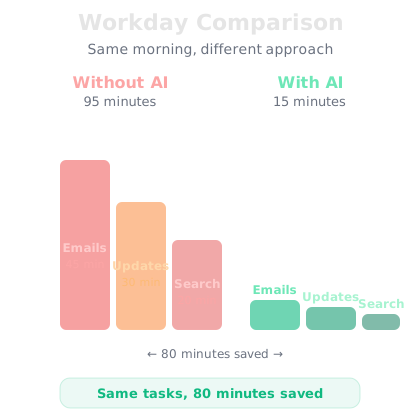
Same tasks, same Tuesday morning. AI doesn't add hours to your day — it gives back the ones you were already losing.
What this course will teach you
Over the next 10 days, you'll build a complete AI productivity system — one skill at a time:
Emails — Draft any message in under a minute and teach AI your writing voice.
Documents — Turn rough notes into polished proposals, reports, and decks.
Meetings — Summarize, extract action items, and draft follow-ups automatically.
Research — Find answers in minutes instead of hours.
Workflows — Chain AI tools together to automate multi-step tasks.
Each lesson is short, practical, and immediately applicable. No fluff. No theory lectures. Just tools and techniques you can use the same day you learn them.
I spend most of my day on emails, meetings, and reports. Can AI actually help with that or is it mostly for creative stuff?
Those are actually the tasks where AI delivers the biggest time savings — because they're structured and repetitive.
Here's what that looks like in practice:
• **Emails:** Describe the situation in one sentence, get a complete draft in 10 seconds. Review, edit, send.
• **Meetings:** Paste in a transcript or your rough notes, get a clean summary with action items in 30 seconds.
• **Reports:** Give AI your data points and key findings, get a formatted first draft in under a minute.
Creative work gets the headlines, but productivity work is where AI saves the most hours per week. Most people reclaim 5-10 hours in the first week alone.
↻ Replay conversation
Knowledge Check
What percentage of knowledge work consists of repetitive cognitive tasks like emails, formatting, and status updates?
A
Over 60%, which is why AI can free up significant time without replacing your core expertise
B
About 40%, which is meaningful but not enough to fundamentally change how your day looks
C
Around 25%, meaning AI helps with a small slice but most work still requires deep thinking
D
Roughly 90%, suggesting that almost all knowledge work could eventually be fully automated
Research shows that over 60% of knowledge work is repetitive cognitive labor — drafting, reformatting, searching, and summarizing. These are the tasks AI handles best, which is why the time savings are so significant without replacing the judgment and creativity that make up the other 40%.
Final Check
In the "tale of two workdays" example, what was the key difference between the AI-assisted morning and the traditional one?
A
The AI-assisted worker skipped low-priority emails entirely and focused only on important ones
B
The same routine tasks were completed in 15 minutes instead of 95, freeing time for deep work
C
The AI handled all communication autonomously so the worker never reviewed any messages
D
The traditional worker was disorganized while the AI user had better planning habits overall
The key difference wasn't skipping tasks or better habits — it was completing the same tasks (emails, updates, document search) dramatically faster. AI handled the drafting and searching, the human reviewed and approved. Same output, fraction of the time.
🚀
Day 1 Complete
"Over 60% of your workday is repetitive cognitive labor. AI doesn't replace your brain — it frees it up for the work that actually matters."
Tomorrow — Day 2
Pick the Right AI Tool in 60 Seconds
Tomorrow you'll learn a simple framework for choosing the right AI tool for any task — so you stop guessing and start getting results.